JUPITER / OTHER WORLDS
✦ foundthevibe.com / other-worlds.htm

DESTINATION 01 / TITAN

Other Worlds

First stop: Titan. A moon that makes patience feel cosmic.

SATURN SYSTEM / ADMIT ONE CURIOUS HUMAN
EXHIBIT 01 / TITAN

Through the
orange haze.

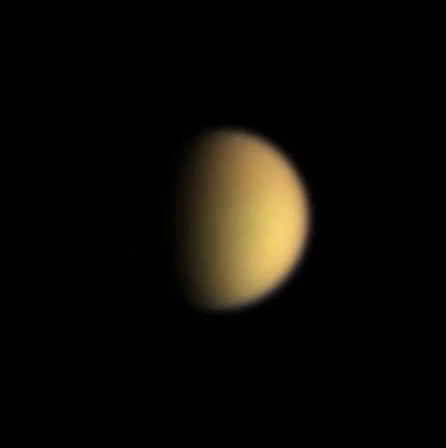
Under that orange veil: dense nitrogen air, methane rain, and lakes of methane and ethane. Familiar weather, with a very different chemistry.

This Cassini view was taken on June 10, 2004, from about 13.1 million kilometers away. The surface stays hidden beneath the haze.

Meet Titan ↗
Titan appears as a small orange crescent against black space in a natural-color Cassini image
Actual Cassini image — natural colorNASA/JPL/Space Science Institute ↗
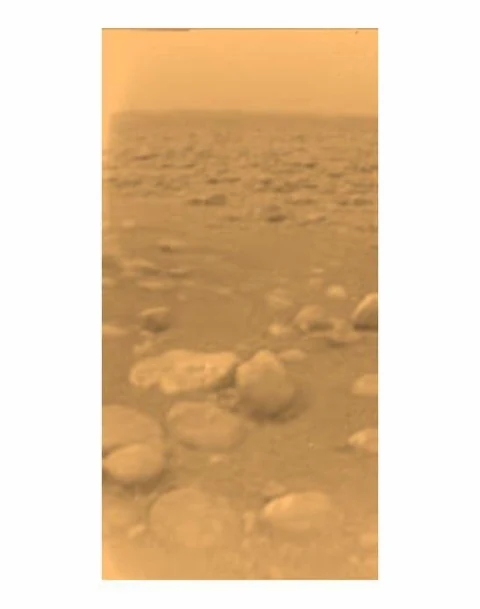
Processed-color Huygens photograph of Titan’s orange surface with rounded pebbles and a hazy horizon
Actual Huygens image — processed colorNASA/JPL/ESA/University of Arizona ↗
EXHIBIT 02 / CASSINI–HUYGENS

Someone
landed here.

On January 14, 2005, Huygens reached Titan’s surface. This is a view from the ground of another moon.

Cassini kept exploring Saturn until September 15, 2017. Its final plunge into Saturn protected potentially habitable moons from contamination.

Joint plans, 1982.
Final signal, 2017.

ABOUT 35 YEARS / FIRST PLANS TO FINAL SIGNAL

~15 yearsPlanning, design & build~7 yearsCruise to Saturn~13 yearsExploring Saturn
  1. Joint planning begins
  2. Design studies
  3. Launch
  4. Saturn arrival
  5. Huygens lands
  6. Cassini’s farewell
Mission timeline ↗ · Early planning history, pp. 11–12 ↗
EXHIBIT 03 / DRAGONFLY

Next departure:
a drone for Titan

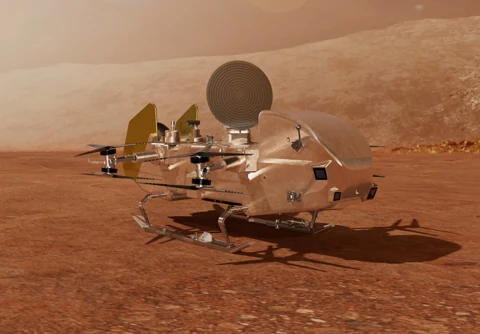
A flying science lab for another world. NASA’s Dragonfly is a robotic drone — a rotorcraft designed to fly between sites on Titan, investigating organic chemistry and the conditions that came before life.

LAUNCH / PLANNEDNo earlier than
July 2028
ARRIVAL / PLANNEDLate 2034

Selected in 2019. Confirmed in 2024. Critical design review in 2025. Integration and testing underway in 2026.

~9 years from selection to launch.
~6 years crossing space.

Follow Dragonfly ↗
Artist’s concept of the Dragonfly rotorcraft resting on Titan’s orange-brown surface
Artist’s concept — not a photographNASA/Johns Hopkins APL ↗

Homepage spacecraft photograph: An actual photograph of the Cassini-Huygens spacecraft during vibration and thermal testing in 1996. Credit: NASA. NASA source & caption ↗ · Original photograph ↗.
Future mission dates are planned and may change. Image credits & sources.

JUPITER FOUNDTHEVIBE ✦ OTHER WORLDS